

 |
 |
 |
 |
 |
 |
 |
 |
 |
 |
 |
 |
 |


First Amendment suspended in the Gulf of Mexico as spill cover-up goes Orwellian
As CNN is now reporting, the U.S. government has issued a new rule that would make it a felony crime
for any journalist, reporter, blogger or photographer to approach any oil cleanup operation, equipment
or vessel in the Gulf of Mexico. Anyone caught is subject to arrest, a $40,000 fine and prosecution for a
federal felony crime.
CNN reporter Anderson Cooper says, "A new law passed today, and back by the force of law and the
threat of fines and felony charges, ... will prevent reporters and photographers from getting anywhere
close to booms and oil-soaked wildlife just about any place we need to be. By now you're probably
familiar with cleanup crews stiff-arming the media, private security blocking cameras, ordinary workers
clamming up, some not even saying who they're working for because they're afraid of losing their jobs."
http://www.naturalnews.com/029130_Gulf_of_Mexico_censorship.html
As CNN is now reporting, the U.S. government has issued a new rule that would make it a felony crime
for any journalist, reporter, blogger or photographer to approach any oil cleanup operation, equipment
or vessel in the Gulf of Mexico. Anyone caught is subject to arrest, a $40,000 fine and prosecution for a
federal felony crime.
CNN reporter Anderson Cooper says, "A new law passed today, and back by the force of law and the
threat of fines and felony charges, ... will prevent reporters and photographers from getting anywhere
close to booms and oil-soaked wildlife just about any place we need to be. By now you're probably
familiar with cleanup crews stiff-arming the media, private security blocking cameras, ordinary workers
clamming up, some not even saying who they're working for because they're afraid of losing their jobs."
http://www.naturalnews.com/029130_Gulf_of_Mexico_censorship.html
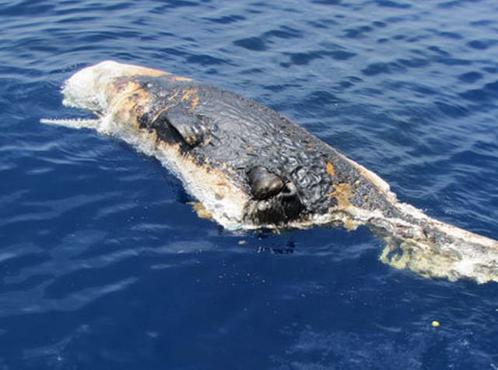
Oil Spill DEAD burned whale COVER UP! This pic is disappearing from the
web... VERY DISTURBING!!!
The photo above comes from AP on June 16. However any and all traces of it have since been
removed. It is possible this is one of the few copies of this left. SHARE IT and lets make sure the
truth is known.
It clearly shows burned flesh on the left side of the body. This whale was burned either alive or
after it died to hide the evidence.
These various articles used to have this photo attached with it but now they do not.
[link to www.nytimes.com]
Spill May Have Taken Its Largest Victim Yet
By LESLIE KAUFMAN
Published: June 17, 2010
Over the last weeks, the carcasses of oily pelicans, turtles and other animals have washed to
shore in the Gulf of Mexico. Now the first dead whale has been found — a juvenile sperm whale
floating 77 miles from the leaking oil well.
Where Oil Has Made Landfall on the Gulf Coast
Multimedia Feature Gulf of Mexico Oil Spill Multimedia Collection
Interactive Map: Tracking the Oil Spill in the Gulf
Slide Show: Readers' Photos: Gulf Oil Spill
Related
BP’s Chief Offers Answers, but Not to Liking of House Committee (June 18, 2010)
Times Topic: Gulf of Mexico Oil Spill (2010)On Tuesday, a National Oceanic and Atmospheric
Administration ship spotted the 25-foot animal due south of the Deepwater Horizon site. The
water the whale was floating in was not oiled. ........................Full story: New York Times.
[link to www.noaanews.noaa.gov]
[link to www.nola.com]
Quote: When you have eliminated the impossible, whatever remains, however improbable, must
be the truth.~Sir Arthur Conan Doyle
web... VERY DISTURBING!!!
The photo above comes from AP on June 16. However any and all traces of it have since been
removed. It is possible this is one of the few copies of this left. SHARE IT and lets make sure the
truth is known.
It clearly shows burned flesh on the left side of the body. This whale was burned either alive or
after it died to hide the evidence.
These various articles used to have this photo attached with it but now they do not.
[link to www.nytimes.com]
Spill May Have Taken Its Largest Victim Yet
By LESLIE KAUFMAN
Published: June 17, 2010
Over the last weeks, the carcasses of oily pelicans, turtles and other animals have washed to
shore in the Gulf of Mexico. Now the first dead whale has been found — a juvenile sperm whale
floating 77 miles from the leaking oil well.
Where Oil Has Made Landfall on the Gulf Coast
Multimedia Feature Gulf of Mexico Oil Spill Multimedia Collection
Interactive Map: Tracking the Oil Spill in the Gulf
Slide Show: Readers' Photos: Gulf Oil Spill
Related
BP’s Chief Offers Answers, but Not to Liking of House Committee (June 18, 2010)
Times Topic: Gulf of Mexico Oil Spill (2010)On Tuesday, a National Oceanic and Atmospheric
Administration ship spotted the 25-foot animal due south of the Deepwater Horizon site. The
water the whale was floating in was not oiled. ........................Full story: New York Times.
[link to www.noaanews.noaa.gov]
[link to www.nola.com]
Quote: When you have eliminated the impossible, whatever remains, however improbable, must
be the truth.~Sir Arthur Conan Doyle
This young Sperm Whale which is on the endangered species list, found burnt
and likely caught in Gulf Oil burn off. One of thousands of undeserving casualties
BP and the Government would much prefer you don't see and get upset about.
So much so they have suspended the first amendment in the Gulf of Mexico.
and likely caught in Gulf Oil burn off. One of thousands of undeserving casualties
BP and the Government would much prefer you don't see and get upset about.
So much so they have suspended the first amendment in the Gulf of Mexico.
| "Shame On Any Government Who Censors These Horrendous Facts From Its People. This I'm Afraid Is What It Really Looks Like In The Gulf. PLEASE Don't Let Them Put Us To Sleep, Its Way Too Serious. This Is The Kind Of Incompetence Inside Each Government and Many Multi-national Companies Like BP - We Have Trusted Them All For Far Too Long". - Colin Andrews |
Shocking State of Affairs - Gulf Oil Update.
I never imaged that I would report such shocking details from
within the United States borders. PLEASE study and ask WHO is
in charge and what is the agenda? Such incompetence we should
not tolerate from which ever administration happen to be in charge
of the peoples business. We MUST learn from this horror and
begin to think of new ways to manage our affairs. To separate
ALL ties between big business and power seeking politicians
might be a good start. They all deserve to be dragged out of
office while we start over. Colin Andrews
I never imaged that I would report such shocking details from
within the United States borders. PLEASE study and ask WHO is
in charge and what is the agenda? Such incompetence we should
not tolerate from which ever administration happen to be in charge
of the peoples business. We MUST learn from this horror and
begin to think of new ways to manage our affairs. To separate
ALL ties between big business and power seeking politicians
might be a good start. They all deserve to be dragged out of
office while we start over. Colin Andrews
| "We Are The Ones, We Are The Revolution" HERE |
This text will be replaced by the player
Anderson Cooper - CNN Report
More than 27,000 abandoned oil and gas wells lurk in the hard rock beneath the Gulf of Mexico,
an environmental minefield that has been ignored for decades. No one -- not industry, not
government -- is checking to see if they are leaking, an Associated Press investigation shows.
The oldest of these wells were abandoned in the late 1940s, raising the prospect that many
deteriorating sealing jobs are already failing.
The AP investigation uncovered particular concern with 3,500 of the neglected wells -- those
characterized in federal government records as "temporarily abandoned."
Regulations for temporarily abandoned wells require oil companies to present plans to reuse or
permanently plug such wells within a year, but the AP found that the rule is routinely circumvented,
and that more than 1,000 wells have lingered in that unfinished condition for more than a decade.
About three-quarters of temporarily abandoned wells have been left in that status for more than a
year, and many since the 1950s and 1960s -- even though sealing procedures for temporary
abandonment are not as stringent as those for permanent closures.
As a forceful reminder of the potential harm, the well beneath BP's Deepwater Horizon rig was
being sealed with cement for temporary abandonment when it blew April 20, leading to one of the
worst environmental disasters in the nation's history. BP alone has abandoned about 600 wells in
the Gulf, according to government data.
There's ample reason for worry about all permanently and temporarily abandoned wells -- history
shows that at least on land, they often leak. Wells are sealed underwater much as they are on
land. And wells on land and in water face similar risk of failure. Plus, records reviewed by the AP
show that some offshore wells have failed.
Asked in multiple requests over several weeks how often abandoned wells have failed, the U.S.
Environmental Protection Agency acknowledged Tuesday -- as this story was being released --
that it has had to deal with leaks at abandoned wells in shallow state waters of Louisiana and
Texas. The U.S. Bureau of Ocean Energy Management, Regulation and Enforcement -- which
oversees wells in federal waters -- also acknowledged Tuesday that it has dealt with "a few" failed
abandoned wells farther out in the Gulf. But the information was released only through the public
affairs offices and neither agency provided experts for follow-up.
Experts say abandoned wells can repressurize, much like a dormant volcano can awaken. And
years of exposure to sea water and underground pressure can cause cementing and piping to
corrode and weaken.
"You can have changing geological conditions where a well could be repressurized," said Andy
Radford, a petroleum engineer for the American Petroleum Institute trade group
Whether a well is permanently or temporarily abandoned, improperly applied or aging cement can
crack or shrink, independent petroleum engineers say. "It ages, just like it does on buildings and
highways," said Roger Anderson, a Columbia University petroleum geophysicist who has
conducted research on commercial wells.
Despite the likelihood of leaks large and small, though, abandoned wells are typically not
inspected by industry or government.
Oil company representatives insist that the seal on a correctly plugged offshore well will last
virtually forever.
"It's in everybody's interest to do it right," said Bill Mintz, a spokesman for Apache Corp., which has
at least 2,100 abandoned wells in the Gulf, according to government data.
Added spokeswoman Margaret Cooper of Chevron U.S.A., which has at least 2,700 abandoned
wells in the Gulf: "It is our experience that the well abandonment process, when performed in
accordance with regulation, has been accomplished safely and successfully."
Greg Rosenstein, a vice president at Superior Energy Services, a New Orleans company that
specializes in this work for offshore wells, maintained that properly plugged wells "do not normally
degrade." When pressed, he acknowledged: "There have been a few occasions where wells that
have been plugged have to be entered and re-plugged."
Officials at the U.S. Interior Department, which oversees the agency that regulates federal leases
in the Gulf and elsewhere, did not answer repeated questions regarding why there are no
inspections of abandoned wells.
State officials estimate that tens of thousands are badly sealed, either because they predate strict
regulation or because the operating companies violated rules. Texas alone has plugged more
than 21,000 abandoned wells to control pollution, according to the state comptroller's office.
Offshore, but in state waters, California has resealed scores of its abandoned wells since the
1980s.
In deeper federal waters, though -- despite the similarities in how such wells are constructed and
how sealing procedures can fail -- the official policy is out-of-sight, out-of-mind.
The U.S. Minerals Management Service -- recently renamed the Bureau of Ocean Energy
Management, Regulation and Enforcement -- relies on rules that have few real teeth. Once an oil
company says it will permanently abandon a well, it has one year to complete the job. MMS
mandates that work plans be submitted and a report filed afterward.
Unlike California regulators, MMS doesn't typically inspect the job, instead relying on the
paperwork.
The fact there are so many wells that have been classified for decades as temporarily abandoned
suggests that paperwork can be shuffled at MMS without any real change beneath the water.
With its weak system of enforcement, MMS imposed fines in a relative handful of cases: just
$440,000 on seven companies from 2003-2007 for improper plug-and-abandonment work.
Companies permanently abandon wells when they are no longer useful. Afterward, no one looks
methodically for leaks, which can't easily be detected from the surface anyway. And no one in
government or industry goes underwater to inspect, either.
Government regulators and industry officials say abandoned offshore wells are presumed to be
properly plugged and are expected to last indefinitely without leaking. Only when pressed do these
officials acknowledge the possibility of leaks.
"Once a well is plugged with cement, it's deemed no longer a risk," said Eric Kazanis, an MMS
petroleum engineer for the Gulf of Mexico. "It's not supposed to leak." He said no special financial
guarantees are required to assure that repairs can be made if they are needed.
Despite warnings of leaks, government and industry officials have never bothered to assess the
extent of the problem, according to an extensive AP review of records and regulations.
That means no one really knows how many abandoned wells are leaking -- and how badly.
The AP documented an extensive history of warnings about environmental dangers related to
abandoned wells:
-- The General Accountability Office, which investigates for Congress, warned as early as 1994
that leaks from offshore abandoned wells could cause an "environmental disaster," killing fish,
shellfish, mammals and plants. In a lengthy report, GAO pressed for inspections of abandonment
jobs, but nothing came of the recommendation.
-- A 2006 Environmental Protection Agency report took notice of the overall issue regarding wells
on land: "Historically, well abandonment and plugging have generally not been properly planned,
designed and executed." State officials say many leaks come from wells abandoned in recent
decades, when rules supposedly dictated plugging procedures. And repairs are so routine that
terms have been coined to describe the work: "replugging" or the "re-abandonment."
-- A GAO report in 1989 provided a foreboding prognosis about the health of the country's inland
oil and gas wells. The watchdog agency quoted EPA data estimating that up to 17 percent of the
nation's wells on land had been improperly plugged. If that percentage applies to offshore wells,
there could be 4,600 badly plugged wells in the Gulf of Mexico alone.
-- According to a 2001 study commissioned by MMS, agency officials were "concerned that some
abandoned oil wells in the Gulf may be leaking crude oil." But nothing came of that warning either.
Told of his employer's supposed worry nearly a decade ago, Kazanis conceded the possibility that
sealing jobs "could be bad."
The study targeted a well 20 miles off Louisiana that had been reported leaking five years after it
was plugged and abandoned. The researchers tried unsuccessfully to use satellite radar images
to locate the leak.
But John Amos, the geologist who wrote the study, told AP that MMS withheld critical information
that could have helped verify if he had pinpointed the problem. "I kind of suspected that this was a
project almost designed to fail," Amos said. He said the agency refused to tell him "how big and
widespread a problem" they were dealing with in the Gulf.
Amos is now director of SkyTruth, a nonprofit group that uses satellite imagery to detect
environmental problems. He still believes that technology could work on abandoned wells.
MMS, though, hasn't followed up on the work. And Interior Department spokeswoman Kendra
Barkoff said agency inspectors would be present for permanent plugging jobs "only when
something unusual is expected." She also said inspectors would check later "only if there's a noted
leak."
Companies may be tempted to skimp on sealing jobs, which are expensive and slow offshore. It
would cost the industry at least $3 billion to permanently plug the 10,500 now-active wells and the
3,500 temporarily abandoned ones in the Gulf, according to an AP analysis of MMS data. Many
such jobs take more than $200,000 and 10 days. Difficult jobs in deep water can cost several
million dollars, and some companies own hundreds of wells.
The AP analysis indicates that more than half of the 50,000 wells ever drilled on federal leases
beneath the Gulf have now been abandoned. Some 23,500 are permanently sealed. Another
12,500 wells are plugged on one branch while being allowed to remain active in a different branch.
Government records do not indicate how many temporarily abandoned wells have been returned
to service over the years. Federal rules require only an annual review of plans to reuse or
permanently seal the 3,500 temporarily abandoned wells, but companies are using this provision
to keep the wells in limbo indefinitely.
Petroleum engineers say abandoned offshore wells can fail from faulty work, age and
drilling-induced or natural changes below the seabed. Maurice Dusseault, a geologist at the
University of Waterloo in Ontario, Canada, says U.S. regulators "assume that once a well is
sealed, they're safe -- but that's not always the case."
"Many of the wells are leaking because they had been inadequately plugged," added Dusseault,
who co-authored a study in 2000 about why oil wells leak.
Even fully depleted wells can flow again because of fluid or gas injections to stimulate nearby wells
or from pressure exerted by underlying aquifers. In a 2007 report, the EPA said of depleted inland
wells: "Although no longer producing, these wells still represent significant sources of oil pollution
and must be properly plugged."
"Even though the fields are depleted, you don't get all the hydrocarbons out," acknowledged
Radford of the petroleum trade group.
Permanently abandoned wells are corked with cement plugs typically 100-200 feet long. They are
placed in targeted zones to block the flow of oil or gas. Heavy drilling fluid is added. Offshore, the
piping is cut off 15 feet below the sea floor.
Wells are abandoned temporarily for a variety of reasons. The company may be re-evaluating a
well's potential or developing a plan to overcome a drilling problem or damage from a storm. Some
owners temporarily abandon wells to await a rise in oil prices.
Since companies may put a temporarily abandoned well back into service, such holes typically will
be sealed with fewer plugs, less testing and a metal cap to stop corrosion from sea water.
"Remember, the sea water penetrates," said Iraj Ershaghi, a University of Southern California
petroleum engineer who has also worked commercially and for the state of California on regulating
offshore wells.
In the Deepwater Horizon blowout, investigators believe the cement may have failed, perhaps
never correctly setting deep within the well. Sometimes gas bubbles form as cement hardens,
providing an unwanted path for oil or gas to burst through the well and reach the surface.
The other key part of an abandoned wells -- the steel pipe liner known as casing -- can also rust
through over time.
"I've seen casing they've pulled out of these old wells. It looks like a worm has eaten it," said
petroleum geologist Norman J. Hyne, who owned inland oil and gas wells in the 1980s as a small
independent producer.
Any holes, cracks or spaces can open a path for repressurized oil or gas to surge to the surface
slowly or, in extreme cases, as a bigger blowout.
Petroleum engineer John Getty, who studies cement properties at Montana Tech, said it is
reasonable to expect that some abandoned offshore wells would leak after decades of aging.
At sea, huge blowouts, like the one at BP's well, would presumably be noticed by nearby rigs or
passing ships. But otherwise these environmental violations generally go unnoticed.
MMS personnel do sometimes spot smaller oily patches on the Gulf during flyovers. Operators are
also supposed to report any oil sheens they encounter. Typically, though, MMS learns of a leak
only when someone spots it by chance.
In the end, the Coast Guard's Marine Safety Laboratory handles little more than 200 cases of oil
pollution each year.
And manager Wayne Gronlund says it's often impossible to tell leaking wells from natural seeps,
where untold thousands of barrels of oil and untold millions of cubic feet of gas escape annually
through cracks that permeate the sea floor.
Oily patches are often attributed to natural leaks. A 2002 report by the National Academy of
Sciences estimated that 60 percent of the oil in North American waters comes from natural seeps,
with most of the remainder from urban runoff, polluted rivers, discharges from boats -- and very
little from oil drilling operations.
But no comprehensive industry or government records are kept on oil leaks from abandoned
wells. And the academy's report cautioned: "Even a small amount released at the wrong time or
place can have a severe impact."
Barkoff, the Interior Department spokeswoman, said discussions are under way on possible ways
of finding leaks from offshore abandoned wells, including the use of undersea robots.
Without strong federal encouragement, though, few researchers are working on the problem.
Source" Fox News: http://www.foxnews.com/us/2010/07/07/gulf-awash-abandoned-oil-gas-wells/
an environmental minefield that has been ignored for decades. No one -- not industry, not
government -- is checking to see if they are leaking, an Associated Press investigation shows.
The oldest of these wells were abandoned in the late 1940s, raising the prospect that many
deteriorating sealing jobs are already failing.
The AP investigation uncovered particular concern with 3,500 of the neglected wells -- those
characterized in federal government records as "temporarily abandoned."
Regulations for temporarily abandoned wells require oil companies to present plans to reuse or
permanently plug such wells within a year, but the AP found that the rule is routinely circumvented,
and that more than 1,000 wells have lingered in that unfinished condition for more than a decade.
About three-quarters of temporarily abandoned wells have been left in that status for more than a
year, and many since the 1950s and 1960s -- even though sealing procedures for temporary
abandonment are not as stringent as those for permanent closures.
As a forceful reminder of the potential harm, the well beneath BP's Deepwater Horizon rig was
being sealed with cement for temporary abandonment when it blew April 20, leading to one of the
worst environmental disasters in the nation's history. BP alone has abandoned about 600 wells in
the Gulf, according to government data.
There's ample reason for worry about all permanently and temporarily abandoned wells -- history
shows that at least on land, they often leak. Wells are sealed underwater much as they are on
land. And wells on land and in water face similar risk of failure. Plus, records reviewed by the AP
show that some offshore wells have failed.
Asked in multiple requests over several weeks how often abandoned wells have failed, the U.S.
Environmental Protection Agency acknowledged Tuesday -- as this story was being released --
that it has had to deal with leaks at abandoned wells in shallow state waters of Louisiana and
Texas. The U.S. Bureau of Ocean Energy Management, Regulation and Enforcement -- which
oversees wells in federal waters -- also acknowledged Tuesday that it has dealt with "a few" failed
abandoned wells farther out in the Gulf. But the information was released only through the public
affairs offices and neither agency provided experts for follow-up.
Experts say abandoned wells can repressurize, much like a dormant volcano can awaken. And
years of exposure to sea water and underground pressure can cause cementing and piping to
corrode and weaken.
"You can have changing geological conditions where a well could be repressurized," said Andy
Radford, a petroleum engineer for the American Petroleum Institute trade group
Whether a well is permanently or temporarily abandoned, improperly applied or aging cement can
crack or shrink, independent petroleum engineers say. "It ages, just like it does on buildings and
highways," said Roger Anderson, a Columbia University petroleum geophysicist who has
conducted research on commercial wells.
Despite the likelihood of leaks large and small, though, abandoned wells are typically not
inspected by industry or government.
Oil company representatives insist that the seal on a correctly plugged offshore well will last
virtually forever.
"It's in everybody's interest to do it right," said Bill Mintz, a spokesman for Apache Corp., which has
at least 2,100 abandoned wells in the Gulf, according to government data.
Added spokeswoman Margaret Cooper of Chevron U.S.A., which has at least 2,700 abandoned
wells in the Gulf: "It is our experience that the well abandonment process, when performed in
accordance with regulation, has been accomplished safely and successfully."
Greg Rosenstein, a vice president at Superior Energy Services, a New Orleans company that
specializes in this work for offshore wells, maintained that properly plugged wells "do not normally
degrade." When pressed, he acknowledged: "There have been a few occasions where wells that
have been plugged have to be entered and re-plugged."
Officials at the U.S. Interior Department, which oversees the agency that regulates federal leases
in the Gulf and elsewhere, did not answer repeated questions regarding why there are no
inspections of abandoned wells.
State officials estimate that tens of thousands are badly sealed, either because they predate strict
regulation or because the operating companies violated rules. Texas alone has plugged more
than 21,000 abandoned wells to control pollution, according to the state comptroller's office.
Offshore, but in state waters, California has resealed scores of its abandoned wells since the
1980s.
In deeper federal waters, though -- despite the similarities in how such wells are constructed and
how sealing procedures can fail -- the official policy is out-of-sight, out-of-mind.
The U.S. Minerals Management Service -- recently renamed the Bureau of Ocean Energy
Management, Regulation and Enforcement -- relies on rules that have few real teeth. Once an oil
company says it will permanently abandon a well, it has one year to complete the job. MMS
mandates that work plans be submitted and a report filed afterward.
Unlike California regulators, MMS doesn't typically inspect the job, instead relying on the
paperwork.
The fact there are so many wells that have been classified for decades as temporarily abandoned
suggests that paperwork can be shuffled at MMS without any real change beneath the water.
With its weak system of enforcement, MMS imposed fines in a relative handful of cases: just
$440,000 on seven companies from 2003-2007 for improper plug-and-abandonment work.
Companies permanently abandon wells when they are no longer useful. Afterward, no one looks
methodically for leaks, which can't easily be detected from the surface anyway. And no one in
government or industry goes underwater to inspect, either.
Government regulators and industry officials say abandoned offshore wells are presumed to be
properly plugged and are expected to last indefinitely without leaking. Only when pressed do these
officials acknowledge the possibility of leaks.
"Once a well is plugged with cement, it's deemed no longer a risk," said Eric Kazanis, an MMS
petroleum engineer for the Gulf of Mexico. "It's not supposed to leak." He said no special financial
guarantees are required to assure that repairs can be made if they are needed.
Despite warnings of leaks, government and industry officials have never bothered to assess the
extent of the problem, according to an extensive AP review of records and regulations.
That means no one really knows how many abandoned wells are leaking -- and how badly.
The AP documented an extensive history of warnings about environmental dangers related to
abandoned wells:
-- The General Accountability Office, which investigates for Congress, warned as early as 1994
that leaks from offshore abandoned wells could cause an "environmental disaster," killing fish,
shellfish, mammals and plants. In a lengthy report, GAO pressed for inspections of abandonment
jobs, but nothing came of the recommendation.
-- A 2006 Environmental Protection Agency report took notice of the overall issue regarding wells
on land: "Historically, well abandonment and plugging have generally not been properly planned,
designed and executed." State officials say many leaks come from wells abandoned in recent
decades, when rules supposedly dictated plugging procedures. And repairs are so routine that
terms have been coined to describe the work: "replugging" or the "re-abandonment."
-- A GAO report in 1989 provided a foreboding prognosis about the health of the country's inland
oil and gas wells. The watchdog agency quoted EPA data estimating that up to 17 percent of the
nation's wells on land had been improperly plugged. If that percentage applies to offshore wells,
there could be 4,600 badly plugged wells in the Gulf of Mexico alone.
-- According to a 2001 study commissioned by MMS, agency officials were "concerned that some
abandoned oil wells in the Gulf may be leaking crude oil." But nothing came of that warning either.
Told of his employer's supposed worry nearly a decade ago, Kazanis conceded the possibility that
sealing jobs "could be bad."
The study targeted a well 20 miles off Louisiana that had been reported leaking five years after it
was plugged and abandoned. The researchers tried unsuccessfully to use satellite radar images
to locate the leak.
But John Amos, the geologist who wrote the study, told AP that MMS withheld critical information
that could have helped verify if he had pinpointed the problem. "I kind of suspected that this was a
project almost designed to fail," Amos said. He said the agency refused to tell him "how big and
widespread a problem" they were dealing with in the Gulf.
Amos is now director of SkyTruth, a nonprofit group that uses satellite imagery to detect
environmental problems. He still believes that technology could work on abandoned wells.
MMS, though, hasn't followed up on the work. And Interior Department spokeswoman Kendra
Barkoff said agency inspectors would be present for permanent plugging jobs "only when
something unusual is expected." She also said inspectors would check later "only if there's a noted
leak."
Companies may be tempted to skimp on sealing jobs, which are expensive and slow offshore. It
would cost the industry at least $3 billion to permanently plug the 10,500 now-active wells and the
3,500 temporarily abandoned ones in the Gulf, according to an AP analysis of MMS data. Many
such jobs take more than $200,000 and 10 days. Difficult jobs in deep water can cost several
million dollars, and some companies own hundreds of wells.
The AP analysis indicates that more than half of the 50,000 wells ever drilled on federal leases
beneath the Gulf have now been abandoned. Some 23,500 are permanently sealed. Another
12,500 wells are plugged on one branch while being allowed to remain active in a different branch.
Government records do not indicate how many temporarily abandoned wells have been returned
to service over the years. Federal rules require only an annual review of plans to reuse or
permanently seal the 3,500 temporarily abandoned wells, but companies are using this provision
to keep the wells in limbo indefinitely.
Petroleum engineers say abandoned offshore wells can fail from faulty work, age and
drilling-induced or natural changes below the seabed. Maurice Dusseault, a geologist at the
University of Waterloo in Ontario, Canada, says U.S. regulators "assume that once a well is
sealed, they're safe -- but that's not always the case."
"Many of the wells are leaking because they had been inadequately plugged," added Dusseault,
who co-authored a study in 2000 about why oil wells leak.
Even fully depleted wells can flow again because of fluid or gas injections to stimulate nearby wells
or from pressure exerted by underlying aquifers. In a 2007 report, the EPA said of depleted inland
wells: "Although no longer producing, these wells still represent significant sources of oil pollution
and must be properly plugged."
"Even though the fields are depleted, you don't get all the hydrocarbons out," acknowledged
Radford of the petroleum trade group.
Permanently abandoned wells are corked with cement plugs typically 100-200 feet long. They are
placed in targeted zones to block the flow of oil or gas. Heavy drilling fluid is added. Offshore, the
piping is cut off 15 feet below the sea floor.
Wells are abandoned temporarily for a variety of reasons. The company may be re-evaluating a
well's potential or developing a plan to overcome a drilling problem or damage from a storm. Some
owners temporarily abandon wells to await a rise in oil prices.
Since companies may put a temporarily abandoned well back into service, such holes typically will
be sealed with fewer plugs, less testing and a metal cap to stop corrosion from sea water.
"Remember, the sea water penetrates," said Iraj Ershaghi, a University of Southern California
petroleum engineer who has also worked commercially and for the state of California on regulating
offshore wells.
In the Deepwater Horizon blowout, investigators believe the cement may have failed, perhaps
never correctly setting deep within the well. Sometimes gas bubbles form as cement hardens,
providing an unwanted path for oil or gas to burst through the well and reach the surface.
The other key part of an abandoned wells -- the steel pipe liner known as casing -- can also rust
through over time.
"I've seen casing they've pulled out of these old wells. It looks like a worm has eaten it," said
petroleum geologist Norman J. Hyne, who owned inland oil and gas wells in the 1980s as a small
independent producer.
Any holes, cracks or spaces can open a path for repressurized oil or gas to surge to the surface
slowly or, in extreme cases, as a bigger blowout.
Petroleum engineer John Getty, who studies cement properties at Montana Tech, said it is
reasonable to expect that some abandoned offshore wells would leak after decades of aging.
At sea, huge blowouts, like the one at BP's well, would presumably be noticed by nearby rigs or
passing ships. But otherwise these environmental violations generally go unnoticed.
MMS personnel do sometimes spot smaller oily patches on the Gulf during flyovers. Operators are
also supposed to report any oil sheens they encounter. Typically, though, MMS learns of a leak
only when someone spots it by chance.
In the end, the Coast Guard's Marine Safety Laboratory handles little more than 200 cases of oil
pollution each year.
And manager Wayne Gronlund says it's often impossible to tell leaking wells from natural seeps,
where untold thousands of barrels of oil and untold millions of cubic feet of gas escape annually
through cracks that permeate the sea floor.
Oily patches are often attributed to natural leaks. A 2002 report by the National Academy of
Sciences estimated that 60 percent of the oil in North American waters comes from natural seeps,
with most of the remainder from urban runoff, polluted rivers, discharges from boats -- and very
little from oil drilling operations.
But no comprehensive industry or government records are kept on oil leaks from abandoned
wells. And the academy's report cautioned: "Even a small amount released at the wrong time or
place can have a severe impact."
Barkoff, the Interior Department spokeswoman, said discussions are under way on possible ways
of finding leaks from offshore abandoned wells, including the use of undersea robots.
Without strong federal encouragement, though, few researchers are working on the problem.
Source" Fox News: http://www.foxnews.com/us/2010/07/07/gulf-awash-abandoned-oil-gas-wells/
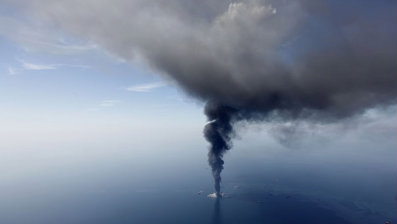
Oh, just so that we get how bad the incompetence is. IF they manage to plug
this super high pressure, super deep well with concrete, keep this in mind: It
will be the 27,001st plugged in the Gulf of Mexico and those are already
showing signs of failing BECAUSE NO ONE CHECKS THEM:
Fox News: 27,000 Wells Abandoned, Unchecked in Gulf
Published July 07, 2010
| Associated Press
this super high pressure, super deep well with concrete, keep this in mind: It
will be the 27,001st plugged in the Gulf of Mexico and those are already
showing signs of failing BECAUSE NO ONE CHECKS THEM:
Fox News: 27,000 Wells Abandoned, Unchecked in Gulf
Published July 07, 2010
| Associated Press
| A Brilliant piece of investigative journalism by Mel Fabregas of the Veritas Show one of just a handful of journalists to be proud of. To understand what is at stake here, PLEASE listen to this show which Mel has kindly donated to us all. Support his show below - The Donated Interview here with Brooks Agnew, Ph.D. http://www.veritasshow.com/veritasplayer.html |
| Select banner to reach The Veritas Show |


News 5 took their own Samples.
51 parts per million on the beach - 66 in the water
Kids playing in 221 parts per million. One exploded.
51 parts per million on the beach - 66 in the water
Kids playing in 221 parts per million. One exploded.