
 |
 |
 |
 |
 |
 |
 |
 |
 |
 |
 |
 |
 |
 |
 |





The International Space Weather Initiative
NASA-Science
Nov. 8, 2010:
Prompted by a recent increase in solar activity, more than a hundred researchers and government
officials are converging on Helwan, Egypt, to discuss a matter of global importance: storms from the
sun. The “First Workshop of the International Space Weather Initiative (ISWI)” meets Nov. 6th through
10th and is convened by the United Nations, the National Aeronautics and Space Administration
(NASA), and the Japan Aerospace Exploration Agency (JAXA).
"Strong solar storms can knock out power, disable satellites, and scramble GPS," says meeting
organizer and ISWI executive director Joe Davila of NASA's Goddard Space Flight Center. "This
meeting will help us prepare for the next big event."
NASA-Science
Nov. 8, 2010:
Prompted by a recent increase in solar activity, more than a hundred researchers and government
officials are converging on Helwan, Egypt, to discuss a matter of global importance: storms from the
sun. The “First Workshop of the International Space Weather Initiative (ISWI)” meets Nov. 6th through
10th and is convened by the United Nations, the National Aeronautics and Space Administration
(NASA), and the Japan Aerospace Exploration Agency (JAXA).
"Strong solar storms can knock out power, disable satellites, and scramble GPS," says meeting
organizer and ISWI executive director Joe Davila of NASA's Goddard Space Flight Center. "This
meeting will help us prepare for the next big event."
| More than a hundred researchers and government officials are converging on Helwan, Egypt, to discuss a matter of global importance: storms from the sun. Posted November 9, 2010 |

A key problem organizers hope to solve is a gap--many gaps, actually---in storm coverage around
our planet. When a big storm is underway, waves of ionization ripple through Earth’s upper
atmosphere, electric currents flow through the topsoil, and the whole planet's magnetic field begins to
shake.
"These are global phenomena," says Davila, "so we need to be able to monitor them all around the
world."
Industrialized countries tend to have an abundance of monitoring stations. They can keep track of
local magnetism, ground currents, and ionization, and provide the data to researchers. Developing
countries are where the gaps are, particularly at low latitudes around Earth's magnetic equator.
Although space weather is usually associated with Earth's polar regions--think, "Northern Lights"--the
equator can be just as interesting. For example, there is a phenomenon in Earth's upper atmosphere
called the "equatorial anomaly." It is, essentially, a fountain of ionization that circles the globe once a
day, always keeping its spout toward the sun. During solar storms, the equatorial anomaly can
intensify and shape-shift, bending GPS signals in unexpected ways and making normal radio
communications impossible.
"International cooperation is essential for keeping track of the equatorial anomaly," he adds. “No
single country can do it alone.”
It's no coincidence that the inaugural meeting of the ISWI is being held in Egypt, an equatorial
country. Of 30 nations sending representatives to the ISWI, more than two-thirds are clustered
around the magnetic equator. This could lead to a revolution in studies of low-latitude space weather.
There is much to do beyond the equator, too. During the meeting, researchers and students will
learn how they can set up monitoring stations for cosmic rays, ground currents, magnetic storms, and
auroras. There’s a phenomenon for every latitude and level of expertise.
"We are offering a whole buffet of research opportunities," says Davila.
Researchers who miss the first meeting will get many more chances. The International Space
Weather Initiative is an ongoing program with get-togethers planned on an annual basis at different
spots around the world. The next meeting will be held in Nigeria in November 2011.
No country is too remote, too small, or too poor to participate. Indeed, notes Davila, "the smallest
most out of the way places are often where data are needed most. Everyone is invited."
Interested? Details and contact information may be found at the ISWI home page: http://iswi-
secretariat.org/
Author: Dr. Tony Phillips | Credit: Science@NASA ( E-mail address: dr.tony.phillips@earthlink.net )
http://science.nasa.gov/science-news/science-at-nasa/2010/08nov_iswi/
our planet. When a big storm is underway, waves of ionization ripple through Earth’s upper
atmosphere, electric currents flow through the topsoil, and the whole planet's magnetic field begins to
shake.
"These are global phenomena," says Davila, "so we need to be able to monitor them all around the
world."
Industrialized countries tend to have an abundance of monitoring stations. They can keep track of
local magnetism, ground currents, and ionization, and provide the data to researchers. Developing
countries are where the gaps are, particularly at low latitudes around Earth's magnetic equator.
Although space weather is usually associated with Earth's polar regions--think, "Northern Lights"--the
equator can be just as interesting. For example, there is a phenomenon in Earth's upper atmosphere
called the "equatorial anomaly." It is, essentially, a fountain of ionization that circles the globe once a
day, always keeping its spout toward the sun. During solar storms, the equatorial anomaly can
intensify and shape-shift, bending GPS signals in unexpected ways and making normal radio
communications impossible.
"International cooperation is essential for keeping track of the equatorial anomaly," he adds. “No
single country can do it alone.”
It's no coincidence that the inaugural meeting of the ISWI is being held in Egypt, an equatorial
country. Of 30 nations sending representatives to the ISWI, more than two-thirds are clustered
around the magnetic equator. This could lead to a revolution in studies of low-latitude space weather.
There is much to do beyond the equator, too. During the meeting, researchers and students will
learn how they can set up monitoring stations for cosmic rays, ground currents, magnetic storms, and
auroras. There’s a phenomenon for every latitude and level of expertise.
"We are offering a whole buffet of research opportunities," says Davila.
Researchers who miss the first meeting will get many more chances. The International Space
Weather Initiative is an ongoing program with get-togethers planned on an annual basis at different
spots around the world. The next meeting will be held in Nigeria in November 2011.
No country is too remote, too small, or too poor to participate. Indeed, notes Davila, "the smallest
most out of the way places are often where data are needed most. Everyone is invited."
Interested? Details and contact information may be found at the ISWI home page: http://iswi-
secretariat.org/
Author: Dr. Tony Phillips | Credit: Science@NASA ( E-mail address: dr.tony.phillips@earthlink.net )
http://science.nasa.gov/science-news/science-at-nasa/2010/08nov_iswi/

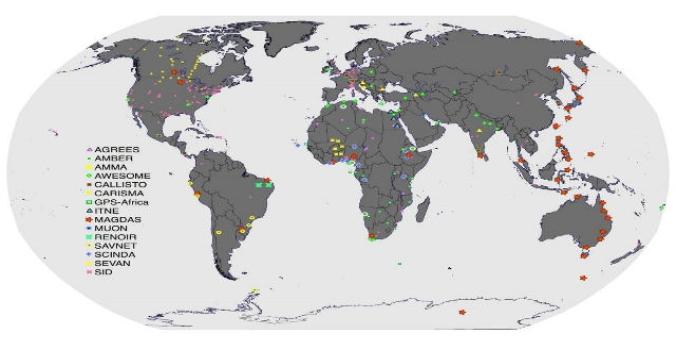
A map of ISWI-brokered space weather monitoring stations. Prospective participants should visit the ISWI home page to
learn more about available projects and how to become involved.
learn more about available projects and how to become involved.
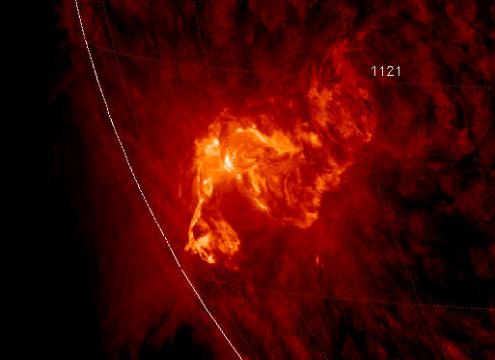
M5 SOLAR FLARE: Active sunspot 1121 has unleashed one of the brightest
x-ray solar flares in years, an M5.4-class eruption at 15:36 UT on Nov. 6th.
Click on the image to view a movie of the blast from NASA's Solar Dynamics Observatory.
x-ray solar flares in years, an M5.4-class eruption at 15:36 UT on Nov. 6th.
Click on the image to view a movie of the blast from NASA's Solar Dynamics Observatory.
SOLAR ACTIVITY UPDATE: After unleashing one of the brightest X-ray flares in years on Saturday,
Nov. 6th, sunspot 1121 took Sunday off. No strong flares were recorded for the rest of the weekend.
Nevertheless, the active region's magnetic field is complex and harbors energy for more eruptions.
NOAA forecasters estimate an 85% chance of M-flares during the next 24 hours.
Nov. 6th, sunspot 1121 took Sunday off. No strong flares were recorded for the rest of the weekend.


Nevertheless, the active region's magnetic field is complex and harbors energy for more eruptions.
NOAA forecasters estimate an 85% chance of M-flares during the next 24 hours.
===============================
| VIEW THE 2012 DEBATE SOLAR CYCLE 24 HERE |
SELECT PHOTO